Executive Leadership & Career Coaching
What is Business Coaching?

Business coaching (BC) is a structured partnership that helps you lead and run better. It goes beyond motivation and turns priorities into choices, and choices into repeatable follow-through.
If you run a business, you already have information. What you may not have is a consistent process for thinking, deciding, and following through under pressure. Business coaching provides that process.
In practical terms, BC helps you improve leader habits that drive results. Gallup's workplace research 1 says managers account for 70% of engagement variance. That makes leader quality a core business variable, not a soft add-on.
What Business Coaching Is and Is Not
BC is a growth process. You and the coach define outcomes, test assumptions, and review commitments each week. The focus is behavior change that improves firm performance.
BC is not outsourcing your judgment. A coach does not become your manager but helps you become better at your own role.
BC is also not consulting by default. Consulting gives expert recommendations for a specific problem. Coaching builds your ability to think clearly and execute with consistency across many problems.
Harvard Business Review's executive coaching review 2 described this well: coaching often supports transitions, development, and confidential problem-solving. That same pattern applies to owners and senior leaders in growing firms.
The Core Components of Business Coaching
Most strong BC engagements include five components:
-
Goal clarity: define one to three outcomes that matter now.
-
Reality check: identify the real constraints in behavior, systems, or structure.
-
Action design: choose specific weekly actions with owners and deadlines.
-
Feedback loop: review what happened and adjust quickly.
-
Accountability rhythm: maintain momentum between sessions.
This rhythm is why coaching works when advice alone fails. Advice can inspire one good week, while a coaching rhythm creates months of consistent progress.
Types of BC
BC is not one thing. Different types solve different problems.
Business Growth Coaching
This type helps owners improve strategy, priorities, and operating systems. It is useful when revenue is growing but execution is uneven.
You might focus on delegation, decision rights, and meeting quality. You might also build a clearer leadership cadence so the owner is not the bottleneck.
Executive Coaching
Executive coaching focuses on leader behavior at senior levels. Themes include decision quality, influence, team talk under pressure, and stakeholder alignment.
This type is common when role complexity increases faster than leader habits. The goal is better range, not more activity.
Leadership Coaching
Leadership coaching builds the skills needed to lead people well. Center for Creative Leadership 3 highlights coaching as a practical development method when behavior change is the goal.
This type often targets feedback quality, delegation, conflict handling, and trust-building routines.
Team Coaching
Team coaching works at group level instead of individual level. It focuses on alignment, communication norms, accountability, and decision rules.
Use this when a team has smart people but poor coordination. Results improve when shared rules become clear and consistent.
Performance Coaching
Performance coaching targets a specific skill or measurable outcome. Examples include executive presence, negotiation, or difficult conversations.
It is narrower than full leadership coaching. It can still produce strong gains when the bottleneck is specific and visible.
How to Choose the Right Type
Start with the bottleneck, not the label.
If your issue is strategic drift and owner overload, business growth coaching is often the best fit. If your issue is senior leader behavior, executive coaching is usually better.
If your issue is team friction, role confusion, or slow cross-team decisions, team coaching may be the fastest lever. If your issue is one critical skill gap, performance coaching can be enough.
You can also combine approaches over time. Many leaders start with one clear bottleneck, then expand once they establish a working coaching rhythm.
What Coaching Looks Like in Practice
A good coaching process is visible. You should know what happens each month.
Month one usually sets direction and baselines. You define outcomes, assess current behaviors, and choose the first routines to change.
Month two usually focuses on follow-through quality. You run weekly commitments, review obstacles, and refine team talk in real situations.
Month three usually focuses on transfer. New habits get embedded into meeting cadence, delegation, and decision-making so progress continues between sessions.
Real Scenarios: What Changes First
In one client team of 10, the owner felt every week was urgent. Meetings were full, but decisions kept slipping. Everyone looked busy, yet priorities changed daily.
In coaching, we set one rule: no new priority without removing an old one. We also added a weekly ownership board with names, dates, and risk flags. Within six weeks, decision rework dropped and delivery improved.
In another coaching engagement with a founder and two managers, tension was rising after a growth push. The founder thought team talk was clear. Managers felt they got direction, then reverse direction, within the same week.
We mapped decision levels, set a feedback script, and added a short Friday reset. Within two months, conflict dropped and managers started bringing options instead of complaints.
These changes were not dramatic speeches, but repeatable routines that improved trust and execution.
Coaching vs Consulting: When Each Wins
Use consulting when you need a technical answer now. Use coaching when you need stronger leader capacity for recurring decisions.
Consulting is often project-based and expert-led. Coaching is often behavior-based and leader-led.
For many firms, the right path is sequence. Use consulting to solve a specific technical gap. Use coaching to make sure leaders can sustain the improvement.
If you are deciding how to lead in different moments, this post on coaching versus managing shows when each mode helps.
What to Expect From a Coaching Relationship
You should expect a clear process, direct feedback, and measurable commitments. You should also expect challenge alongside support.
You should leave each session with actions, dates, and ownership. If sessions end without commitments, progress usually fades.
You should also expect honesty about limits. Coaching cannot fix a broken business model alone. It cannot replace expert skill you do not have.
The relationship works best when both coach and client do the work. The coach holds structure. The client takes action.
What Business Coaching Cannot Do
Good coaching has boundaries, and those boundaries protect outcomes.
Coaching cannot make hard trade-offs disappear. It cannot remove market pressure. It cannot replace leader courage in difficult moments.
Coaching also cannot work if commitments are optional. If sessions are reflective but not operational, results remain shallow.
A credible coach is explicit about these limits. That honesty is part of trust.
How to Measure Progress
Measure behavior and firm outcomes together. Do not rely on mood.
Start with a small scorecard: decision cycle time, priority stability, escalation quality, and one team signal such as turnover risk or role clarity. Add one commercial metric linked to your current goal.
You can also track leader habits directly. Better listening and clear expectations often lead to better decisions. This guide on active listening is a useful baseline for that work.
If you need a practical frame for team talk under pressure, this article on what a business coach does complements the process in this post.
When those indicators improve for two to three months, coaching is likely working.
A Simple Weekly BC Loop
You can run coaching with one short loop each week. Keep the loop clear, and keep it light.
Step one is review. Check what you said you would do, what you did, and what blocked progress.
Step two is choose. Pick one key goal for the week and one risk that could slow it.
Step three is act. Set the next actions, one owner for each action, and a due date.
Step four is close. Write a short note with choices made, tasks due, and help needed.
This loop works because it is easy to repeat. It also cuts stress because people know what is next.
If the loop breaks, do not add more tools first. Fix the basics: clear goals, clear owners, and clear due dates.
In my work with small firms, this loop is often the point where ideas turn into real gains.
Choosing the Right Coach
Ask how they structure diagnosis, action plans, and follow-up. Ask what metrics they use. Ask how they respond when a client misses commitments.
Ask for examples of similar situations beyond polished success stories. You want pattern recognition, not perfect case studies.
Test chemistry in a real conversation, and make sure you feel both supported and challenged.
Finally, ask what they will not do. Strong coaches define scope clearly and refer out when another service is better.
Let's Build Brilliance Together
BC works when it is practical, measurable, and consistent. It helps you build better leader habits that your team can feel in daily work.
If you want structured support, Executive Leadership & Career Coaching gives you a clear process for decisions, team talk, and follow-through.
If you want to explore fit and priorities, reach out for a free consultation. No pressure, just an honest conversation about where you are and what needs to change first.
Research Notes & Sources
If you want to go deeper, these are the studies and reports behind the key points in this post.
- State of the Global Workplace Report(gallup.com)
- What Can Coaches Do for You?(hbr.org)
- Leadership Coaching Services(ccl.org)
Category & Tags
Frequently Asked Questions
What is business coaching?
Business coaching is a structured partnership that helps owners and leaders improve decisions, execution, and leadership behavior. A coach guides your thinking, challenges assumptions, and helps you follow through on clear actions.
How does coaching differ from consulting?
Consulting gives expert recommendations for a specific problem. Coaching builds your ability to lead, decide, and execute through questions, reflection, and accountability. Many growing firms use both at different times.
Which type of business coaching is right for me?
Choose based on your main bottleneck: strategy and systems, executive decision quality, leadership behavior, or team dynamics. The right coach helps you define one priority outcome and build around that.
What should I expect from coaching?
Expect regular sessions, clear goals, weekly commitments, and direct feedback. You should leave each session with specific actions, owners, and dates. Most engagements run at least three to six months.
About the Author

About the Author
Mark Mayo
Head Coach, MBC
We get up each morning excited about sharing our 20-plus years of business acumen with small business owners and their teams. Collaborating with hard-working owners to achieve their personal and business goals brings rewards. When we develop you and grow your leaders, we create the momentum that moves you and your business forward. It starts with a first step. Then we can build brilliance together.
Related Articles

Decision Paralysis: Why Leaders Freeze and How to Start Moving Again
Fast decisions are nearly 2x more likely to be good ones. Five practical frameworks help leaders break decision paralysis and lead with clarity.
Read Decision Paralysis: Why Leaders Freeze and How to Start Moving Again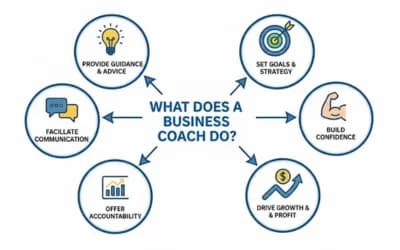
What Does a Business Coach Do?
A business coach partners with you to clarify goals, develop leadership skills, and build accountability. Learn what coaching involves and find your fit.
Read What Does a Business Coach Do?
What Can A Business Coach Help With?
Business coaches help with leadership, strategic planning, team building, and transitions. Discover where coaching makes the biggest difference.
Read What Can A Business Coach Help With?